When purchasing an overhead crane, one of the most fundamental decisions buyers face is choosing between a single girder and a double girder design. While capacity and price are often the first parameters discussed, the structural differences between these two crane types play a far more decisive role in determining safety, performance, service life, and long-term return on investment.
This article explains the structural distinctions between single girder and double girder overhead cranes from a buyer’s perspective, helping decision-makers understand not just what the differences are, but why they matter in real operating conditions.
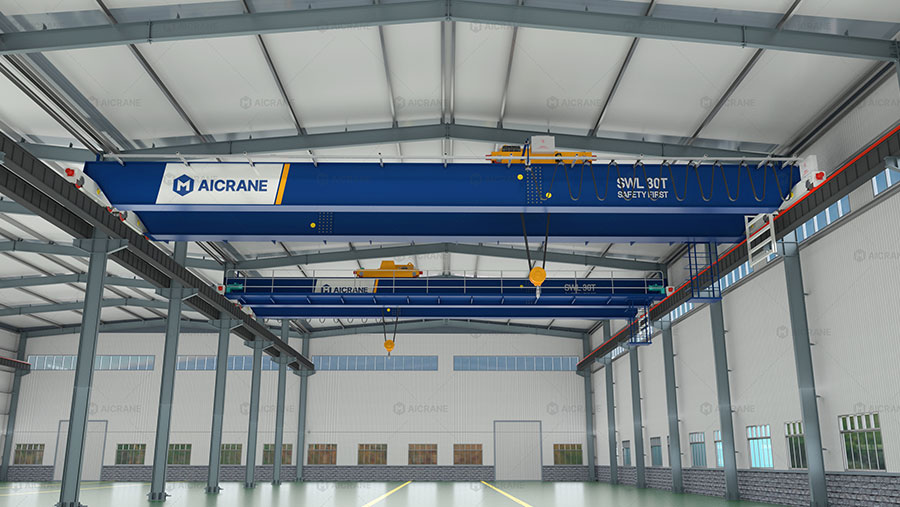
1. Basic Structural Configuration: One Girder vs Two Girders
The most visible difference lies in the main load-bearing structure.
A single girder overhead crane uses one main girder, typically a box girder or I-beam, spanning between two end carriages. The hoist travels along the bottom flange of the girder or runs on a lower rail attached to it.
A double girder overhead crane, by contrast, features two parallel main girders connected by cross beams. The trolley runs on rails mounted on top of these girders.
From a structural standpoint, this difference fundamentally affects load distribution, stiffness, redundancy, and scalability.
2. Load Path and Structural Load Distribution
Single Girder Load Path
In a single girder crane, all vertical loads (rated load, hoist weight, dynamic forces) are transmitted through one primary girder. This girder must handle:
-
Bending stress
-
Shear forces
-
Torsional effects caused by off-center loads
As a result, single girder bridge cranes rely heavily on precise structural calculation and often require thicker plates or reinforced sections as capacity increases.
Double Girder Load Path
In a double girder crane, the load is shared between two girders. The trolley distributes forces symmetrically, reducing stress concentration on any single structural member.
For buyers, this means:
-
Lower stress per girder
-
Better overall structural balance
-
Higher tolerance to dynamic loads and impact forces
Buyer takeaway: Double girder cranes offer superior load distribution, especially for heavy or frequently lifted loads.
3. Structural Stiffness and Deflection Control
Structural stiffness directly influences lifting stability, sway control, and positioning accuracy.
-
Single girder cranes have lower overall stiffness due to a single bending member. As span and capacity increase, deflection becomes a limiting factor.
-
Double girder cranes achieve much higher stiffness because two girders work together, significantly reducing vertical deflection.
From a buyer’s perspective:
-
Less deflection means smoother operation
-
Reduced load swing improves safety
-
Higher stiffness supports precision lifting tasks
This difference is especially important in industries such as machinery manufacturing, power plants, and steel processing, where lifting accuracy matters.
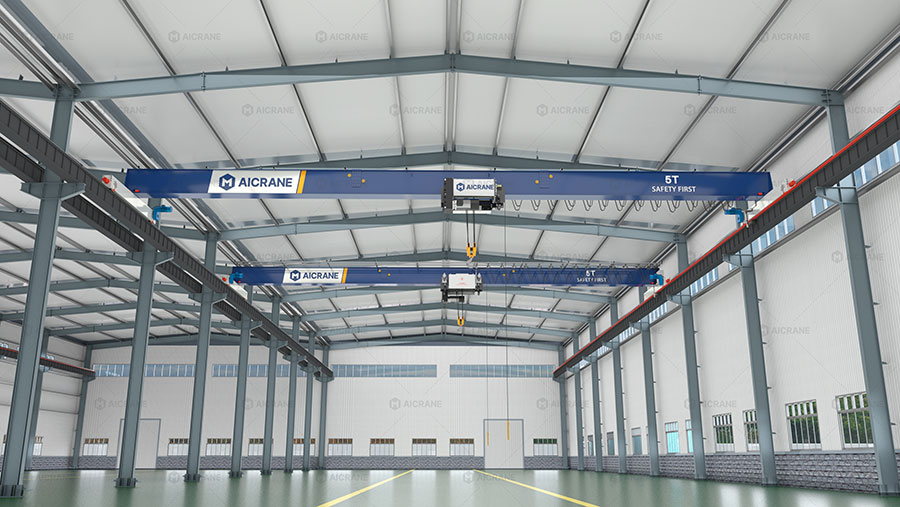
4. Structural Redundancy and Safety Margin
Structural redundancy refers to how well a structure can tolerate abnormal conditions without failure.
-
A single girder eot crane has limited redundancy. If the main girder develops a structural issue, crane operation must stop immediately.
-
A double girder crane inherently provides better redundancy, as loads are shared and structural failure risk is reduced.
For buyers operating in:
-
High-risk environments
-
Heavy-duty cycles (A5–A8)
-
Critical production lines
Double girder structures offer greater inherent safety margins, which is often reflected in longer service life and fewer unplanned shutdowns.
5. Lifting Height and Headroom Utilization
Structural configuration also determines usable lifting height, a critical factor for workshop layout.
Single Girder
The hoist typically runs below the girder, which reduces available lifting height. While modern European single girder designs optimize headroom, structural limits remain.
Double Girder
The trolley runs on top of the girders, allowing the hook to lift closer to the roof structure.
Buyer insight: In workshops where vertical space is limited but lifting height is critical, double girder cranes offer a structural advantage despite higher initial cost.
6. Capacity and Span Scalability
From a purely structural perspective:
-
Single girder cranes are structurally efficient for light to medium capacities, typically up to 20–25 tons depending on span and duty class.
-
Double girder cranes scale much more effectively for:
-
Large spans
-
High capacities (30 tons to 500+ tons)
-
Heavy duty applications
-
As capacity increases, a single girder must become disproportionately heavier to maintain stiffness, whereas double girder structures scale more naturally.
For buyers planning future expansion, double girder cranes offer greater flexibility for:
-
Capacity upgrades
-
Higher duty cycles
-
Advanced trolley systems
7. Structural Fatigue and Duty Class Performance
Overhead cranes rarely fail due to static overload; fatigue is the real structural challenge.
-
Single girder cranes experience higher stress cycles concentrated in one girder.
-
Double girder cranes distribute fatigue stresses, improving endurance under repetitive loading.
For buyers operating:
-
Continuous shifts
-
High lifting frequency
-
Production-critical cranes
Double girder structures generally provide longer fatigue life, aligning better with high duty classifications.
8. Structural Integration with Runway and Building
The crane structure does not work alone – it interacts with runway beams and building steel structures.
-
Single girder cranes exert lower wheel loads, reducing runway beam requirements.
-
Double girder cranes impose higher loads but distribute them more evenly.
From a buyer’s EPC or plant design perspective:
-
Single girder cranes may reduce building costs
-
Double girder cranes may require stronger runways but deliver higher operational capability
The right choice depends on whether the project prioritizes lower upfront construction cost or long-term operational performance.
9. Maintenance and Structural Accessibility
Structural design also affects inspection and maintenance:
-
Single girder cranes have simpler structures but limited access for internal inspection.
-
Double girder cranes provide better access platforms, walkways, and maintenance space.
For buyers managing large facilities, easier inspection translates into:
-
Improved safety compliance
-
Faster maintenance
-
Lower lifecycle cost
10. Cost vs Structural Value: A Buyer’s Perspective
While single girder cranes are more economical initially, buyers should evaluate total value rather than purchase price alone.
| Aspect | Single Girder | Double Girder |
|---|---|---|
| Initial cost | Lower | Higher |
| Structural stiffness | Moderate | High |
| Capacity scalability | Limited | Excellent |
| Fatigue life | Moderate | Long |
| Safety margin | Standard | Higher |
| Long-term ROI | Good for light duty | Better for heavy duty |
Conclusion: Choosing the Right Structure for Your Operation
For buyers, the choice between a single girder and double girder overhead crane is fundamentally a structural decision, not just a budget one.
-
Choose a single girder crane if your application involves lighter loads, moderate duty cycles, limited span, and strong cost sensitivity.
-
Choose a double girder crane if your operation demands high capacity, long spans, intensive use, precise lifting, and long-term reliability.
Understanding the structural differences allows buyers to align crane design with operational reality – ensuring safety, efficiency, and a return on investment that extends far beyond the initial purchase.